
Anchovy Protection Act of 2020
Due to resent events and unsustainable practices within the anchovy fishing industry the oceans of Aquawaves have run out of fishing stocks. Therefore, in order to create a more sustainable environment and ensure that such a crisis does not happen again the government has intervened by implementing new legislation, The Anchovy Protection Act of 2020. The Act places more stringent regulation on the Anchovy fishing industry, however such regulations are essential when considering several factors
Concepts underpinning our approach to Sustainability
Sustainability
Sustainability has become an integral part of all decisions and actions taken by businesses. Sustainability can be divided into three main pillars: Social, Economic and Environmental Sustainability. Social Sustainability requires that we support the lives of our employees, stakeholders and local community by ensuring continued employment and supporting local community upliftment projects. Economic Sustainability requires that we remain profitable but achieve this in an ethical way and avoid conflicts of interests. Environmental Sustainability relates to how we obtain our raw materials, and to do so in such a way that it does not disrupt or deplete the ecological balance within the oceans of Aqua Waves. Sustainability can be divided into two separate positions, namely: Weak sustainability and Strong sustainability.
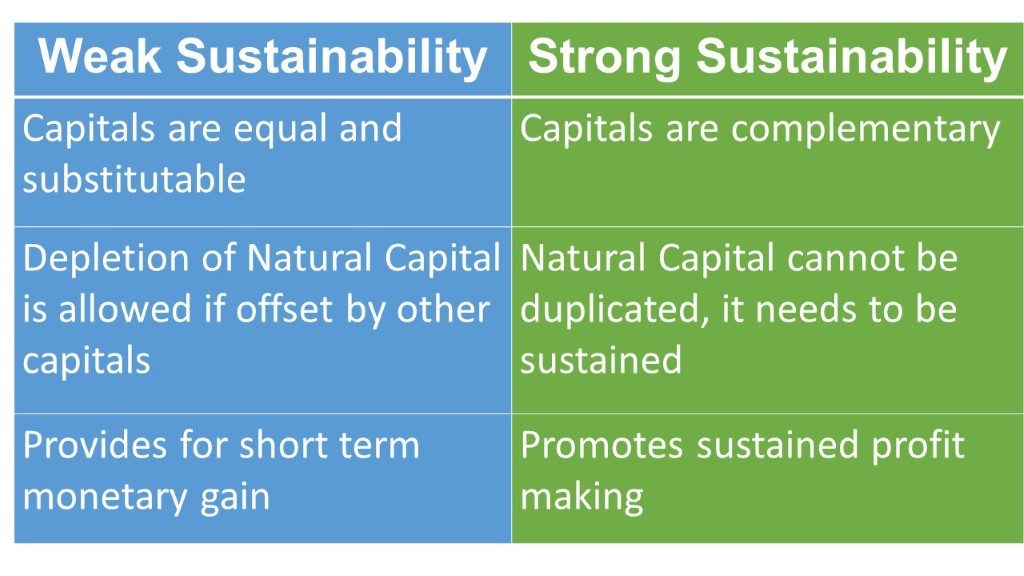
The idea behind Weak Sustainability is simply that the depletion of natural resource or capital is allowed, so long as it is offset by an increase in other forms of capital. This means that all forms of capital, even natural and manufactured, are equal and interchangeable. This policy of sustainability allows for short term monetary gain to take preference over the state of the environment. To simplify this ideology of sustainability we apply it to our situation: It would be acceptable for Anchor Management to over fish the Anchovy in the oceans of Aquawaves, so long as the over fishing results in an equal or larger increase in products and other capital.
Strong Sustainability is based on the understanding that all the capitals are not equal, rather that the different capitals are complementary. This policy of sustainability accepts that natural capital cannot be duplicated by manufactured capital, therefore it needs to be maintained and enhanced. In our case, once we have fished all the anchovy in Aqua Waves, we cannot manufacture more anchovy, we therefore need to adopt sustainable fishing practices to ensure that we do not deplete our natural resources. Furthermore, without natural capital for manufactured capital to process, manufactured capital to a large extent becomes obsolete. Therefore, by maintaining the level natural capital, we ensure a sustained income generating capacity for the future.
Resource Depletion
Resource depletion occurs when natural resources such as water, oil and the global fish population, are consumed at a greater rate than they are able to replenish. Overpopulation, pollution as well as poor farming, mining and fishing practices are just a few of the causes of resource depletion, however the underlying issue is that government and large corporations fail to pursue and implement effective and long-lasting solutions. Instead temporary fixes and half measures are enacted in an attempt to postpone the inevitable.
Resource depletion is a major issue that impacts individuals, communities, businesses and the global economy. This is because natural resources are integral to the functioning of society, for example, a major decline in global fish stocks would lead to massive job loss, the collapse of industries and jeopardisation of global food security, in short, our way of life would be at risk.
Tragedy of the commons
Proposed by British economist William Forster Lloyd in 1833 and popularised by American biologist and philosopher Garrett Hardin in 1968, the tragedy of the commons is a situation where acting in one’s self-interest goes against the actions that benefit all users of a resource.
This can be illustrated using 4 fishermen and a pond with a maximum capacity of 12 fish. In this example, 2 fish are needed to produce 1 more that would be fully grown in a day. If each fisherman caught only 1 fish each day, the remaining 8 would be able to reproduce 4 more fish and keep the pond at a maximum. A rational fisherman would think that there won’t be any damage if he caught more than 1 fish for himself; and how can he be sure all the others aren’t also catching more than 1?
This is where the tragedy comes in, if each fisherman acts in self-interest or doesn’t trust the other fishermen to play by the rules, there would be a decline in fish until its completely depleted and none of them will be able to catch any more fish. To prevent the tragedy of the commons, there can be: privatisation of resources, top down regulation or bottom up institutions.
Externalities
This economic term refers to a cost or benefit that is created not within the control of a third party. However, the third party pays or receives this cost or benefit. Therefore, an externality can be positive and negative, created by consuming a good or service. The cost or benefit could affect a select amount of people.
Externalities can be illustrated by the destruction of the coral reefs by trawlers negatively, which affects the tourism industry and underwater divers. Social impacts such as air pollution from the burning of fuels to run a sea vessel are an example of externalities that affect the whole society.
The graph below illustrates the effects of externalities. The price at point B does not include the price of externalities society pays when this good or service is sold or produced. Thus, the government implements tax or regulations on the product or service to increase the price so that the quantity produced and consumed reaches point A. In this way, government can put funds towards preventing or depleting negative externalities. Positive externalities on the other hand will not be taxed, but rather subsidized by the government, as they improve society.

Sustainable Yield
According to the Food and Agriculture Organisation of the United Nations (FAO), sustainable yield (catch) can be defined as “the number (weight) of fish in a stock that can be taken by fishing without reducing the stock biomass from year to year, assuming that environmental conditions remain the same.” This means that if ecological condition remains constant from year to year, a certain amount of fish can be caught without having the base population, required for effective reproduction, decline.
The maximum sustainable yield (MSY) is the maximum quantity that can be caught indefinitely for the fishing population to maintain the base capital amount and for the fish population not to decline. The growth rate of fish occurs in between fishing seasons. During the fishing season the MSY will be caught allowing the fish population to reproduce an equivalent amount to MSY during the off-season again.
This sustainable yield is set by government regulations, other organisations and voluntary industry codes. The South African government sets regulations in terms of the Consultative National Environmental Policy Process (CONNEPP) which limits anchovy fishing activities to ensure that sustainable fishing is achieved. Another government initiative are the establishment of marine protected areas where any fish species within this area is fully protected for conservation, experimental fishing and scientific study. The government achieves sustainable yields mainly through issuing vessel permits and setting a total allowable catch. All the conditions that fishing companies must comply with are set up yearly by the Department of Agriculture, Forestry and Fisheries (another means of ensuring sustainable yield).
In order to be allowed to partake in commercial fishing activities in South Africa, the business must have a commercial fishing right, a vessel permit. According to the South African government: a business is only allowed to apply for a commercial fishing right upon invitation in the Government Gazette. If the commercial right is granted, it is for a period between eight and ten years. It is illegal to engage in commercial fishing without this right. In this way the government can regulate the number of vessels allowed to catch anchovies or any other fish species. Total Allowable Catch (TAC) is the total catch allowed to be taken from a resource (in this case: anchovies) in a specified period, as defined by the regulatory body. It is allocated in specific quantities or proportions (e.g. tonnage) depending on the ecological conditions. Currently, the TAC is set at 100 000 tons for anchovies.
Sustainable yield fishing is also achieved through the voluntary codes followed by companies. Companies have become more aware of voluntary codes, such as their Corporate Social Responsibility, in order to gain attention from media and customers, which in turn results in increased sales. These voluntary codes provide an incentive for fishing businesses to comply with sustainable yield fishing in order to appeal to customers. If these companies do not follow these codes consumers will be less likely to buy their products and this compels companies to follow voluntary industry codes.


 Group E4:15